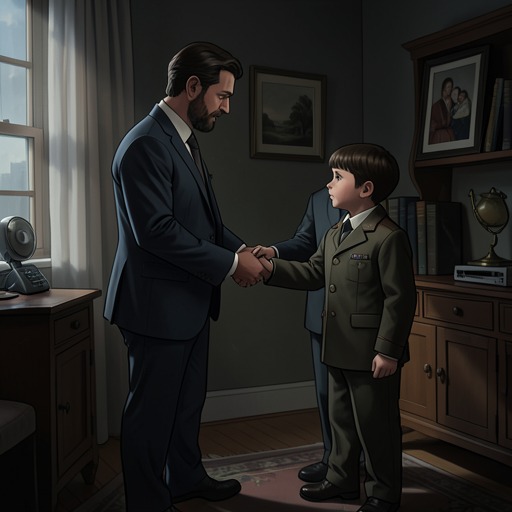
Sempere family bookshop
The Shadow of the WindThe Sempere family bookshop is both the working heart of Daniel’s family and a refuge whose quiet routines are repeatedly pressed upon by the novel’s mysteries. Its counter and door mark the boundary between ordinary business and the dangers surrounding Julian Carax’s books: a place where father and son sustain one another, where Daniel and Fermín organize their next moves, and where the history of Carax’s near-erased work eventually comes back into view.
Family, Work, and Early Attachments
The shop belongs to the everyday world Daniel shares with his father, whose limited means shape their life without diminishing his generosity. When Daniel imagines that owning Victor Hugo’s fountain pen might make him a writer, his father promises to buy it if he finishes his first work. Daniel’s literary ambition soon gives way to mechanical toys and wind-up boats, and he stops asking about the pen. The recollection nevertheless fixes the shop’s emotional background: Daniel remembers his father as a thin man in an oversized old suit and a secondhand hat, unable to afford an object that seemed to his son to mean everything. The promise matters less as a purchase than as an expression of faith in Daniel’s possibility.
Later, the bookshop gives Daniel and Fermín a shared place of work and a practical base for friendship. After the two devise a plan with Gustavo Barceló, they agree to test whether they are under police surveillance by walking to Els Quatre Gats; Daniel is to say nothing to his father, whom they expect would worry. The investigation therefore begins in deliberate tension with the shop’s family life: its occupants depend on trust, yet Daniel and Fermín conceal their movements from the man who runs it.
A Base for Secrecy and Investigation
That concealment becomes a daily strain. The morning after Daniel spends a sleepless night, he and Fermín follow their arrangement by inventing separate reasons to leave: Daniel pretends to take a walk, while Fermín says he has an appointment to have stitches removed. Daniel is unsettled by the prospect of systematically lying to his father. Fermín reassures him that small lies are part of family life, but the reassurance also reveals how far the investigation has entered the bookshop: their work now requires them to turn the household’s ordinary confidence into cover.
Daniel’s return makes the shop’s routines visible in another way. He arrives nearly forty-five minutes late, and his father points out that he had been left alone while needing to visit a client in San Cugat. The exchange is ordinary, but it carries the cost of Daniel’s divided loyalties: the mystery draws him away from work and from the person whose trust has long sustained him. The bookshop is not merely a convenient setting for the investigation; it is the obligation against which Daniel measures the deception required to continue it.
The Shop Under Surveillance
After Nuria Monfort is murdered and Fermín is missing, Daniel’s father insists on opening the shop as usual. The decision serves as a declaration of Fermín’s innocence at a moment when police scrutiny has entered the family’s immediate surroundings. An officer watches the door to the stairs and another keeps watch near Plaza Santa Ana. Rain falls through the day; neighbors glance in through the window, but no customers come inside. The shop remains open in form while public suspicion empties it of its ordinary trade.
The page reporting Nuria’s murder lies on the counter. Daniel’s father rereads it every twenty minutes, saying little and communicating his anger through gestures. The counter, ordinarily the place of exchange between bookseller and customer, becomes the surface on which the family confronts the news and the police presence outside. Keeping the doors open does not undo the danger, but it refuses to treat Fermín as guilty or the family’s business as already defeated.
Daniel later returns carrying a bag from Don Federico and passes the plainclothes policeman guarding the shop. The officer gives the bag only a vague glance; Daniel slips inside, where his father is still standing behind the counter. The brief passage links the threshold, the police watch, and the family’s interior life: even a small errand becomes part of the effort to move through surveillance without drawing attention. When his father begins to apologize for what he said, Daniel tells him not to worry and acknowledges that his father was right, restoring a measure of understanding after the strain of secrecy.
Carax’s Books and the Shop’s Later Life
The bookshop’s world is tied to the precarious physical survival of Carax’s work. Isaac explains that Cabestany published eight of Carax’s novels between 1928 and 1936, even though one of the better-selling titles, The Red House, sold only about ninety copies. When a buyer offered the publisher’s son three times the market value for the remaining stock, Daniel recognized that the books were meant to be burned. The son’s attempt to demand still more money ended the offer; a few days later, Cabestany’s warehouse in Pueblo Nuevo burned down. Nearly all the Carax books were lost, but the secretary Nuria had independently rescued one copy of every title. The episode gives the book trade a double role: books are vulnerable stock that can be destroyed, but their preservation also depends on individual acts of care.
That history reaches the Sempere family bookshop again in the years after the main events. Gustavo Barceló closes his own bookshop and sells his stock to the Sempere family. He then establishes a publishing company devoted to reissuing Carax’s works. Its first volume gathers three novels recovered from a set of proofs that had ended up in a furniture warehouse belonging to the Cabestany family; it sells 342 copies, far fewer than the year’s bestseller. The modest figure contrasts with the scale of the earlier loss, but publication itself marks a change: Carax’s writing has moved from near-total destruction back into circulation.
The shop also receives the final, personal sign that Carax has returned to writing. After Daniel visits the restored Aldaya mansion, a parcel bearing a Paris postmark arrives at the bookshop. It contains The Angel of Mist, published under the name Boris Laurent. Daniel recognizes the writing at once, and the book’s dedication identifies him and Beatriz as the people who helped restore the author’s voice and life. The bookshop thus becomes the destination for a message that is also evidence: Carax is alive, writing again, and able to address Daniel directly.
A Place of Memory and Return
The bookshop’s significance comes from the way private memory and public history meet there. Daniel’s childhood recollection of his father’s promise, the later pressure of police surveillance, and the return of Carax’s novels all gather around a working family business rather than a grand institution. Its doors can be watched, its customers can disappear, and its trade can be shaped by books lost elsewhere; nevertheless, it continues to serve as a place where stories are kept and renewed.
In the ending, the arrival of Carax’s new novel does not erase the years of concealment, loss, and danger. Instead, it changes what the shop can hold: alongside the bookselling work and the memories Daniel shares with his father, it receives proof that a writer once thought lost has regained both his voice and his pen. The Sempere family bookshop is therefore not simply a setting for Daniel’s investigations. It is the durable domestic space from which he enters the mystery and to which its surviving books and relationships return.